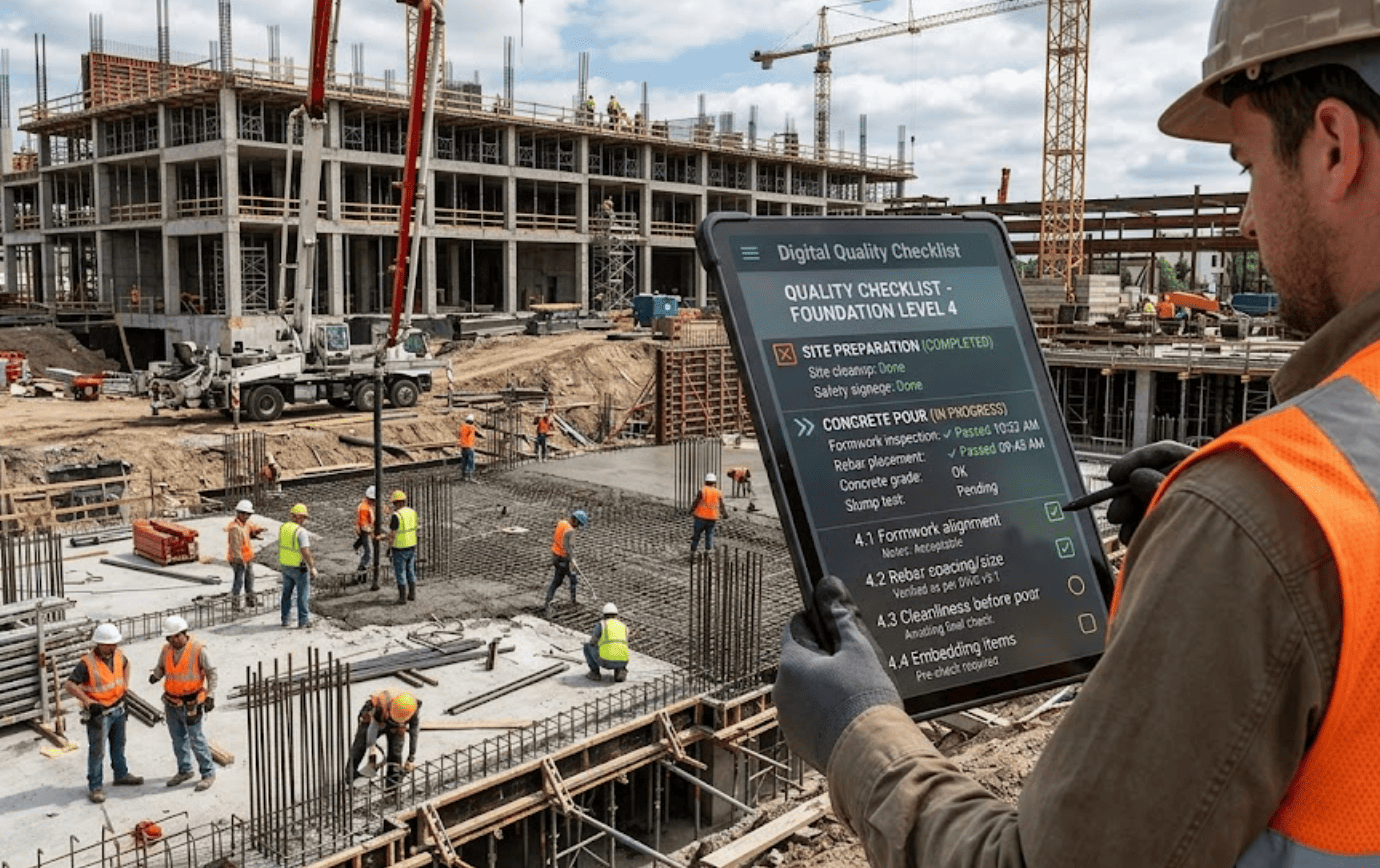

Commercial real estate construction management software gives developers one controlled environment for scope, schedule, cost, risk, documents, approvals and reporting across design, construction and handover. The right system connects project-level workflows—RFIs, submittals, change orders, pay applications, inspections and claims—to owner-level measures such as forecast at completion, contingency burn, yield on cost, IRR and NOI stabilisation.
That distinction matters because a development director is not managing only a site. They are managing capital exposure, lender and JV reporting, investment committee decisions, entitlement and design risk, contractor performance and the handover of an asset into operations. For a mixed-use scheme, hospitality development or retail rollout, the system must provide both a reliable project record and a portfolio view.
Why Real Estate Developers & Development Directors Need Purpose-Built Software for this segment
Commercial development rarely follows the boundaries of a single contractor’s project. A developer may be coordinating land and entitlement work, design packages, procurement, construction, tenant requirements, lender drawdowns and operational readiness at the same time. A mixed-use programme may also contain separate reporting structures for retail, residential, hospitality or office components, each with different delivery dates and commercial measures.
The financial exposure is material. Large construction projects typically take 20% longer than scheduled and can be up to 80% over budget, according to McKinsey Global Institute’s February 2017 report. EY’s review of large capital projects valued above US$1 billion found that 64% experienced cost overruns and 73% experienced schedule delays. These are cross-industry benchmarks, not forecasts for an individual development, but they show why early warning and governance belong in the owner’s operating model.
Developers also carry obligations beyond construction delivery. PwC and ULI’s Emerging Trends in Real Estate 2024 identified construction and entitlement delays, cost escalation and lender demands for more frequent reporting as major developer concerns. A lender or equity partner may require the latest budget versus GMP, contingency drawdown, critical-path movement, change-order attribution, risk mitigations, progress photographs and certifications in one reporting pack.
Without a controlled data environment, that pack is often assembled manually from spreadsheets, email, shared drives, PDF reports and contractor systems. KPMG’s 2015 Global Construction Project Owner’s Survey found that only 25% of owners had a single, fully integrated project management information system; most relied on spreadsheets and multiple disconnected tools. FMI and PlanGrid reported that 35% of construction professionals’ time was spent on non-productive activities such as finding information, resolving conflicts and correcting mistakes.
Consider a development director overseeing a mixed-use urban asset alongside 40 retail rollout sites. The urban project has a pending design change affecting core-and-shell completion, while several retail sites face permitting delays and long-lead equipment issues. The director needs to know which changes affect the lender draw, which approvals are outstanding, whether the retail sites share a vendor or jurisdiction risk, and whether a delay moves the NOI stabilisation date. A site-by-site dashboard does not answer that question. A programme-level record with linked cost, schedule, document and risk data can.
Core Requirements Checklist (must-have vs nice-to-have features)
Start with the developer’s governance model and financial structure, not with a list of screens. The system should reflect the way the organisation approves capital, reports to stakeholders and measures asset performance.
| Requirement | Must-have or nice-to-have | What to test |
|---|---|---|
| Common data environment | Must-have | Can drawings, specifications, RFIs, submittals, correspondence, inspections and meeting records be managed with version control and clear ownership? ISO 19650 principles provide a recognised reference for information management across the asset lifecycle. |
| Owner cost and contract controls | Must-have | Can the team compare budget, commitments, actuals and forecast at completion; track allowances and contingencies; and route change orders, pay applications and extensions of time for approval? |
| Programme and portfolio views | Must-have | Can the developer standardise work breakdown structures, cost codes, templates and reporting across phases, assets and sites? |
| Lender and JV reporting | Must-have | Can live data produce draw request packs containing progress, cost, schedule, changes, risks, photographs and certifications? |
| Workflow and audit trail | Must-have | Does the record show who approved what, when, under which delegation and against which document version? |
| Field, quality and safety controls | Must-have | Can the team manage inspections, defects, snagging, safety events, punch lists and closeout evidence? |
| Role-based collaboration | Must-have | Can owners, PMCs, consultants, contractors, designers, tenants and other parties access the information relevant to their role? |
| AI document and risk intelligence | Nice-to-have differentiator | Can AI identify obligations, compare documents, flag risk and prepare draft actions while leaving consequential sign-off with a person? |
| Cross-project procurement | Nice-to-have differentiator | Can the team compare tenders and monitor vendors across hospitality or retail sites rather than treating every package as isolated? |
| Handover and asset data | Nice-to-have differentiator | Can approved records, O&M information, defects and closeout evidence remain usable by property and facilities teams? |
Financial alignment deserves particular attention. A developer’s pro forma may include land, hard costs, soft costs, tenant improvements, leasing commissions and financing costs. Construction cost codes may instead follow trades or CSI divisions. The implementation should map those structures so a change order can be traced from package level to contingency, forecast, yield on cost and investment reporting.
For a retail rollout, test template reuse, site-level exceptions and go-live dependencies. For mixed-use, test whether the system can report linked phases while keeping separate covenants, budgets and approval chains. For hospitality, test procurement visibility for FF&E and the connection between construction completion, commissioning and opening readiness.
Common Pitfalls With Generic/Contractor-First Tools
A contractor-first workflow is not automatically unsuitable. Contractors need strong tools for drawings, RFIs, submittals, inspections, schedules and cost administration. The issue is whether the developer can use the same information to govern a programme, protect capital and report to stakeholders.
Project visibility without programme control
A collection of project dashboards may still leave the development director unable to compare phases, sites, jurisdictions or asset classes. Standardised cost codes, risk categories and templates are needed to identify patterns such as repeated permitting delays, rising RFI volumes or vendor issues across a portfolio.
Construction budgets disconnected from the pro forma
If project data remains separate from the developer’s investment model, the team may see a change order without seeing its effect on contingency, financing, yield on cost, IRR or the NOI stabilisation timeline. Integration or controlled data exchange with systems such as Yardi, MRI, SAP, Oracle NetSuite or Anaplan should be assessed against the organisation’s actual finance process.
Manual reporting and weak evidence trails
Email and spreadsheets make it difficult to establish the approved version of a drawing, the basis for a change, or the person responsible for an overdue decision. Arcadis reported that owner-directed changes and poor contract administration were among leading causes of global construction disputes in 2023; the average dispute value was US$42.8 million and the average duration was 16.3 months across sectors.
Detail without an owner-level signal
A development director does not need every field record in every executive meeting. They need a defensible signal: which critical-path activities moved, which change orders threaten contingency, which risks lack mitigation, and which assets are likely to miss a leasing or opening milestone. The system should preserve detail while presenting the decision that detail supports.
Comparison Snapshot — Leading Platforms for This Segment
There is no single category that fits every developer. The choice usually sits among several approaches, and pricing for the named enterprise platforms is generally custom or quote-based rather than a publicly comparable figure.
| Approach | Documented strengths | Questions for a developer |
|---|---|---|
| Contractor-first construction platforms | Often support field collaboration, drawings, RFIs, submittals, quality, safety, schedules and cost workflows. | Can the owner retain the programme record, apply its own approval chains and compare risk across projects? |
| Procore | Procore describes a cloud construction management platform for contractors, subcontractors and owners. Its owner offering includes capital project controls, portfolio dashboards, budget and change management, correspondence and document control. Product information also describes schedule integrations, RFIs, submittals, reporting, vendor directories and bid management. | How will the configuration map to the developer’s pro forma, lender reporting, governance and long-term data-retention requirements? CRE-specific customer numbers and standard pricing are not publicly specified. |
| Autodesk Construction Cloud | Autodesk describes a connected environment spanning design, planning and execution. Its documented capabilities include documents, drawings, models, RFIs, submittals, issues, field management, cost management, dashboards and model coordination through products including Autodesk Build, Autodesk Docs, Takeoff and BIM Collaborate Pro. | How will model, document, cost and approval data become an owner-level programme view? CRE-specific adoption figures and enterprise bundle pricing are not publicly specified. |
| Oracle Primavera and Oracle Construction and Engineering | Oracle documents Primavera P6 for detailed scheduling, Primavera Unifier for capital programme management and workflows, and Aconex for collaboration and document control. The portfolio includes stage-gate approvals, cost and contract management, audit trails and correspondence logs. | Can the organisation configure the workflow without separating schedule, CDE, financial and investment reporting? Pricing is quote-based. |
| AI-native CDE approach | Combines a common data environment with AI that reviews project information, identifies patterns and prepares workflow actions across documents, controls and risks. | What evidence supports the AI output, where is human approval required, and can the platform preserve a reliable owner-controlled record? |
The comparison should be made against the developer’s operating model rather than a generic feature count. Test a live scenario: approve a design change, update the forecast, assess the critical-path effect, prepare the lender narrative and preserve the supporting evidence. The platform that handles that chain with the fewest manual transfers is closer to the owner’s real requirement.
What an AI-Native Approach Adds (agent-based automation, predictive controls)
AI is useful here when it is connected to governed project data and specific workflows. A chatbot that cannot cite the drawing, specification, contract clause or approval history is not a substitute for project controls.
Document intelligence can review a submittal or RFI against drawings and specifications, identify relevant references and assign a confidence score. It can draft an RFI response with cited sources, while a qualified person remains responsible for sign-off. The same principle applies to extracting obligations, notice periods, service levels and options from contracts, consultant appointments and leases.
Agent-based automation can monitor an approval chain, route an overdue submittal, prepare a change-order summary, assemble evidence for a draw request or identify an inspection that blocks closeout. The agent should create a traceable proposed action, not silently make a consequential decision.
Predictive controls work at package, project and portfolio level. A system can look for combinations such as rising RFI volumes, repeated inspection failures, late submittals and procurement movement that may indicate cost or schedule exposure. BCG estimated in 2020 that AI applications could increase productivity by up to 50% for some construction tasks and reduce project costs by up to 15%; these are industry-wide estimates, not platform-specific guarantees. McKinsey estimated that full-scale digitalisation in non-residential construction could produce 4–6% cost reductions and 20–30% time savings through better controls, collaboration and data use.
For developers, the practical question is not whether AI sounds advanced. It is whether the system can explain why a project or asset has been flagged, show the underlying evidence, and let the development director decide what happens next.
Zepth Core’s unified project record applies this owner-side principle across documents, quality and safety, site operations, project controls and risk management. Zepth AI’s agent layer reviews project information, drafts responses with references and surfaces risk while keeping human approval in the workflow.
Implementation Considerations for this segment
Begin with the information model. Define the work breakdown structure, cost codes, asset and phase hierarchy, document naming, risk categories and approval delegations before importing records. Map these to the developer’s pro forma and accounting structures rather than accepting a contractor’s project taxonomy as the programme standard.
Specify the common data environment in contracts and information requirements. The delivery team should know which system is authoritative, who can issue or approve information, how revisions are controlled and what must be retained at closeout. ISO 19650 offers a reference point for information management roles and processes; FIDIC-aligned workflows may also matter where they form part of the contractual environment.
Plan integrations around the decisions the owner needs to make. Common candidates include accounting and ERP systems, Primavera P6 or Microsoft Project for scheduling, real estate financial systems, document repositories and asset management tools. Avoid integrations that simply duplicate fields without defining which system owns the data.
Adoption extends beyond the internal development team. GCs, CMs, architects, consultants, suppliers and tenants may all contribute records. Contract language, onboarding, role-based access and practical training should explain what each party must submit, by when and through which workflow.
A phased rollout can reduce disruption: establish the owner taxonomy and reporting first, onboard a new project or controlled pilot, then extend to in-flight projects and the wider portfolio. Retain long-term access to project records for claims, insurance, audits and operations. The owner should not depend on an individual contractor’s account or a collection of exported PDFs to reconstruct the project later.
How to Build the Business Case
Build the case around avoided exposure and better decisions, not a generic promise of productivity. Establish the current cost of assembling reports, reconciling budgets, finding documents, chasing approvals and responding to claims. FMI and PlanGrid found that 61% of owners identified poor project data and information flow as key contributors to project problems, while poor information and communication accounted for 48% of rework in their 2018 research. Autodesk and FMI later reported that 52% of rework globally was associated with poor project data and communication.
Then connect the operational measures to investment outcomes:
- Capital control: budget versus forecast at completion, contingency burn, allowance exposure, change-order value and contractor-versus-owner attribution.
- Schedule protection: baseline variance, critical-path movement, procurement lead times, entitlement milestones and the effect of delay on leasing, opening or NOI stabilisation.
- Governance: approval cycle times, overdue decisions, evidence completeness, notice compliance and the number, value and duration of disputes or claims.
- Portfolio learning: recurring risks by market, asset class, vendor, trade or template; standardisation across retail sites; and lessons carried into the next deal.
A simple model starts with annual portfolio CapEx and the internal and external project-management effort used to control it. Estimate the hours spent on reporting, reconciliation and document retrieval, then identify the financial effect of a delayed decision, missed notice or unplanned contingency draw. Use the McKinsey and BCG ranges as directional external benchmarks only; they are not guaranteed savings from any particular product.
Compare the resulting value with subscription, implementation, integration, training and ongoing administration costs. The relevant denominator is not the number of users. It is the cost and risk of governing the development programme. For a platform that does not charge per seat or per collaborator, evaluate whether broad participation improves the completeness of the owner’s project record without creating a separate commercial penalty for each consultant, contractor or stakeholder.
For an owner-side platform example, Zepth Edge connects development budgets, CapEx and MIS reporting to the wider project record, while Zepth Vector supports tendering, contracts, vendors and three-way invoice matching. Together with Zepth Core and Zepth AI, the model is designed to give the development team a controlled record from procurement through delivery and asset reporting.
To turn the assessment into a practical selection exercise, schedule a walkthrough and request the commercial development framework and checklist.
FAQ (schema-marked)
What is commercial real estate construction management software, in plain terms?
Commercial real estate construction management software helps developers and their partners plan, execute and control office, retail, hospitality, industrial and mixed-use construction, including scope, schedule, budget, risks, documents, approvals and handover. It typically includes workflows for RFIs, submittals, change orders, pay applications, inspections and lender reporting.
Why does commercial real estate construction management software matter for Real Estate Developers?
It matters because developers carry the capital risk and must connect construction performance to yield on cost, IRR, NOI stabilisation, lender reporting and equity decisions. Integrated information can also reduce the manual reconciliation and poor data flow associated with rework, delays and weak project governance.
How is commercial real estate construction management software typically done today, and where does it break down?
It is often delivered through a mix of spreadsheets, email, shared drives, contractor-controlled platforms and separate scheduling, accounting and document tools. It breaks down when data is disconnected, portfolio risks are hard to compare, approval evidence is incomplete and lender or investment reporting requires manual assembly.
What does a modern, AI-native approach to commercial real estate construction management software look like?
It uses a common data environment as the controlled project record and applies AI to extract information, compare documents, identify potential cost and schedule risks, route workflow actions and surface portfolio patterns. Human reviewers remain responsible for approving consequential responses, changes and commitments.
What KPIs or metrics should teams track related to commercial real estate construction management software?
Track forecast at completion, contingency burn, schedule variance against baseline, critical-path movement, RFI and submittal cycle times, change-order volume and attribution, defects, rework, safety events, procurement lead times and vendor performance. At portfolio level, track on-time and on-budget delivery, NOI stabilisation dates, leasing milestones, yield on cost, IRR effects and dispute frequency, value and duration.