
Hospitality analytics and insights have become the foundation of modern hotel management software, providing hoteliers with a unique edge: the ability to turn guest data into actionable revenue strategies. As hotels face tighter competition and greater guest expectations, harnessing the potential of data across your portfolio is crucial. With intelligent platforms like Zepth Edge, hotels move beyond guesswork, leveraging performance dashboards, AI-driven decision tools, and real-time hospitality analytics to optimize profitability, asset reliability, and guest experience from the ground up.
Understanding Hospitality Analytics: Intelligence That Drives Results
At its core, hospitality analytics refers to the collection, integration, and analysis of data streams from operational, guest-facing, and on-property systems—everything from PMS and POS, to booking engines, loyalty programs, and guest surveys. This deepens understanding of guest behavior and preferences, sharpens pricing and inventory controls, and empowers better asset and financial management. But as hotel asset management platforms evolve, analytics now span beyond the walls of a single property, connecting hotel groups, brands, and owners with portfolio-level performance monitoring and AI-driven foresight.
Consider a question hoteliers often ask: How do hotels use guest data to increase revenue? The answer lies in turning historical and real-time information about bookings, spend, feedback, and operational performance into live, data-driven decisions. This ranges from revenue management and pricing, to personalizing offers and optimizing cost centers such as housekeeping and maintenance. Studies reveal that companies effectively leveraging customer data can outpace peers by up to 85% in sales growth, and more than 25% in gross margin—affirming the strategic value of digital transformation in the hospitality industry.
The Analytics Spectrum: Descriptive to Prescriptive Insights
Smart hotel management tools structure analytics across four key domains:
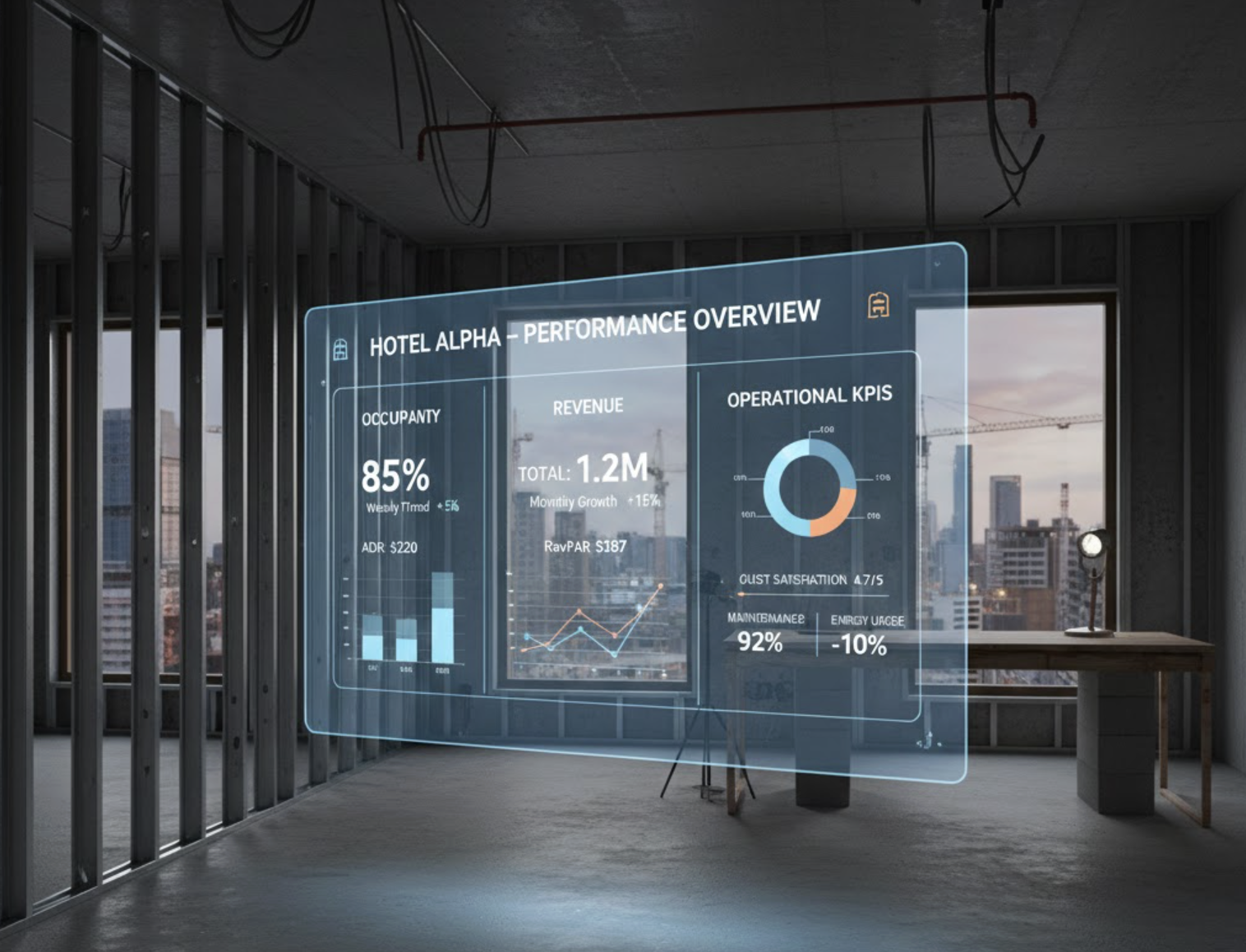
- Descriptive analytics summarize the past—tracking KPIs like occupancy, ADR, RevPAR, guest satisfaction, booking pace, and cost breakdowns—giving managers visibility into “what happened” across rooms, outlets, and segments.
- Diagnostic analytics dig deeper, answering “why did it happen?” through cohort, variance, and root cause analyses. For instance, a sudden drop in RevPAR can be traced to high-cost OTA bookings or negative reviews prompted by service lapses.
- Predictive analytics forecast guest demand, booking behaviors, cancellations, upgrade acceptance, and even churn risk by harnessing machine learning and statistical models across historical and live data streams.
- Prescriptive analytics recommend specific actions: adjusting rates dynamically, allocating inventory to the right channels, or deploying personalized offers to micro-segments—all supporting improved portfolio performance with AI-powered hospitality management systems.
One common query: What are the most important KPIs for hotel analytics? Operators typically focus on Occupancy %, ADR, RevPAR, GOPPAR, booking conversion rates, guest satisfaction scores, and staff productivity. Modern solutions extend visibility, integrating real-time asset reliability, channel performance analytics, and compliance for a 360-degree operational overview.
Revenue Transformation: Concrete Use Cases for Guest Data
The real value of analytics emerges in the practical ways that hospitality platforms translate guest information into revenue growth and efficiency gains:
1. Revenue Management & Dynamic Pricing: AI in hospitality takes historic and current demand signals—like competitor rates, event calendars, and booking velocity—to power automated pricing engines. Analytics-driven hotel CAPEX control software helps managers adjust rates on the fly, implementing best-available-rate (BAR) strategies and segment-specific promotional fences. These AI hotel automation platforms have lifted RevPAR by 5–15% for many adopters.
2. Personalization and Experience Optimization: Hospitality analytics and insights pinpoint guest preferences, enabling hotels to customize everything from amenities to upgrade offers, making each stay more tailored and driving both loyalty and increased per-stay spend. This approach leverages AI tools for hotels to improve outcomes, with research suggesting that 91% of consumers are more likely to engage with personalized brands.
3. Cross-sell and Ancillary Revenue Maximization: Smart portfolio performance management identifies high-opportunity micro-segments for upselling spa access, late checkout, parking, or F&B packages. This data-driven hospitality management boosts TRevPAR by up to 30% when combined with event-driven, in-journey nudge marketing.
4. Channel Optimization: A hotel portfolio management system equipped with AI-driven performance dashboards gives managers direct insight into channel mix, cost, and ROI—enabling strategic shifts from high-cost OTAs to direct and corporate channels. Even marginal shifts lead to 3–10% margin improvements, thanks to reduced commission and better guest data control.
5. Marketing and Loyalty Analytics: Advanced hospitality analytics segment and target high-CLV (customer lifetime value) guests, measure campaign attribution, and predict churn—ensuring budgets are optimized and loyalty programs deliver repeat revenue without excessive points liability.
6. Operational Efficiency and Cost Optimization: With hospitality forecasting tools and hotel OPEX management, operators optimize labor schedules, preventive maintenance, and supply costs, driving down operating expenses while boosting guest satisfaction metrics like NPS and online review scores.
7. Reputation & Sentiment Analytics: Platforms like Zepth Edge use sentiment analysis to proactively address guest complaints, highlighting correlations between review scores, service quality, and revenue. Improving these parameters can directly support premium pricing and occupancy lift—just a 1-point review score gain can translate into tangible ADR improvements.
Data Foundations: Integration, Quality, Privacy, and Compliance
With hotels juggling numerous on-premise, cloud-based, and mobile solutions, a cloud-based hospitality management system must address significant data integration challenges. Hospitality’s fragmented legacy architecture—multiple PMS, POS, CRM, and operational tools—creates hurdles like duplicate guest profiles, unlinked touchpoints, and delayed reporting. Top hotel financial management software centralizes these threads, creating a single source of truth through unified guest IDs, property-level integration, and portfolio dashboards.
Best-in-class platforms offer:
- Central data warehouses integrating all guest and operational data
- AI asset management software that links asset lifecycles, CAPEX, and guest impact
- Role-based permissions and data lineage for improved compliance and security
- Automated data cleansing and deduplication for a trustworthy analytics backbone
- Privacy features supporting GDPR, CCPA, and other regulatory frameworks, including consent-aware personalization and transparent preference management
It’s common for hospitality professionals to wonder: What are the key privacy requirements for guest data analytics in hotels? Legal mandates include obtaining explicit consent for marketing, providing data access and deletion rights, limiting data use to disclosed purposes, and ensuring robust breach notification processes. High-performing hotel compliance and audit software automates much of this, reducing risk while maintaining the benefits of real-time hospitality data analytics.
Emerging Trends: AI, IoT, and Portfolio Intelligence at the Edge
The intersection of AI and hotel management continues to broaden the scope of analytics-powered transformation. Next-generation hospitality platforms are defined by:
AI-Driven Revenue Management: Platforms deploy machine learning to predict demand at a granular level, adjust prices in near real-time, and test pricing elasticity. Hotel CAPEX optimization and OPEX control software use these forecasts to fine-tune investment and operational decisions.
Real-Time Personalization: Smart hotel management tools engage guests contextually—pushing offers for spa appointments, F&B, or room upgrades based on live occupancy and guest history, using in-app, SMS, or even voice assistants.
IoT and Smart Rooms: Asset lifecycle management for hotels captures device-generated data—tracking room occupancy, energy use, HVAC health, and amenity status—enabling predictive maintenance and supporting sustainability goals.
Voice and Conversational Analytics: Guests interact through chatbots, in-room smart speakers, or text, with all interactions generating granular analytics around FAQs, service requests, and upsell acceptance, revealing new operational and revenue opportunities.
Portfolio-Level Benchmarking: AI-driven hotel management connects asset-level analytics, empowering owners and investors with portfolio-wide benchmarking. Identifying outliers or best practices across multiple properties drives faster, data-rich CAPEX planning and operational standardization.
ESG and Sustainability Analytics: Real-time monitoring of energy, water, and waste translates green initiatives into both cost savings and marketable sustainability credentials—responding to guest and corporate demand for responsible travel options.
The Zepth Edge Advantage: Hospitality Data from Concept to Operations
Zepth Edge stands apart as a hotel asset management platform by uniting traditional construction and project control analytics with in-depth hospitality performance intelligence. For owners, operators, and asset managers, this means:
CAPEX and Asset Intelligence: Zepth Edge digitizes capital expenditure planning—from initial budgeting for renovations or expansions to lifecycle tracking of guest-facing enhancements. Asset register and asset disposal modules create an audit-ready record, while CAPEX management streamlines approvals and financial tracking, supporting smarter hotel budgeting and forecasting.
Operational Readiness and Handover: As properties transition from construction to operations, Zepth delivers structured asset registers and documentation, ensuring maintenance, warranty, and compliance details are at the fingertips of every operator. This foundation is critical to long-term service excellence, powering future integrations with IoT and AI hospitality management systems.
Holistic Portfolio Oversight: For multi-property portfolios, Zepth Edge provides real-time intelligence on financial performance, risk, schedule adherence, and operational readiness. Owners and investors gain visibility across projects and in-operation assets, enabling agile capital allocation and revenue-positive decision-making in sync with market analytics and guest data platforms.
Service Quality and MIS Reporting: Integrated MIS reporting pulls together occupancy, financials, asset reliability, and guest satisfaction—accelerating responses and closing feedback loops. Seamless operations and service modules empower hotel teams to swiftly manage guest experiences from one digital nucleus, enhancing both operational agility and the guest journey.
Best Practices: Turning Insights Into Revenue, Step by Step
The most successful hotel operations align analytics with business goals and build a culture that moves from data collection to data action. Key recommendations include:
- Define specific objectives—whether increasing RevPAR, reducing guest complaints, or accelerating direct bookings—to focus analytics efforts.
- Centralize guest and operations data for a unified, accurate view.
- Pilot high-ROI use cases—like dynamic pricing or service recovery analytics—on select properties, then scale proven methods portfolio-wide.
- Embed actionable analytics into daily workflows: use high-value guest alerts, upsell opportunity prompts, and predictive maintenance flags to drive revenue and efficiency in real time.
- Invest in training and cross-functional collaboration: empower revenue, marketing, and ops teams with basic analytics literacy and share learnings broadly.
- Maintain transparency and trust with guests, using robust compliance systems and clear, opt-in personalization to enhance satisfaction without overstepping privacy boundaries.
It’s also worth reflecting on a frequent industry question: How can hotels use analytics for sustainability and ESG goals? Energy and water use per room, waste reduction, and carbon footprint metrics can be tracked alongside guest satisfaction and occupancy, leveraging sustainability as both a revenue driver and a differentiator in the market.
Powering the Next Generation of Hospitality Revenue
Winning in today’s hotel landscape is about more than superior service—it’s about using data and analytics to make every guest interaction and operational decision smarter, faster, and more profitable. From descriptive dashboards to AI-led operational intelligence in hotels, platforms like Zepth Edge ensure that your properties aren’t just running—they’re outperforming. Hospitality analytics and insights, once a competitive perk, are now the engine of sustainable, data-driven hospitality management. For hotel leaders embracing digital transformation, the future is clear: every byte of guest data is a building block for more revenue, higher standards, and an unassailable edge.